Week 1
The Hallway, Not The Street
- Start indoors, with no smells and no dogs
- Three metres, back and forth, marker on every slack leash
- Five minutes, twice a day
- The street is week three, not week one
Module · the daily walk
Four weeks to a slack leash — using the walks you were already taking.
The dog pulls, you follow, he arrives where he wanted. That is a reward delivered four hundred times a year with perfect consistency. No collar fixes an arrangement that good. This module breaks it in four weeks, using the same marker and timing the method taught.
Take the module$37one-time · 60-day money-back guarantee
What you get out of it
What a handler does differently
Police, detection and assistance dogs are not trained with more force than yours. They are trained with better information. Six differences, none of which costs anything, and all of which are missing from almost every household.
None of this is a secret. It is simply what gets taught on a handler's course and almost never reaches the person who bought a puppy, because nobody wrote it down in a form that fits twenty minutes a day.
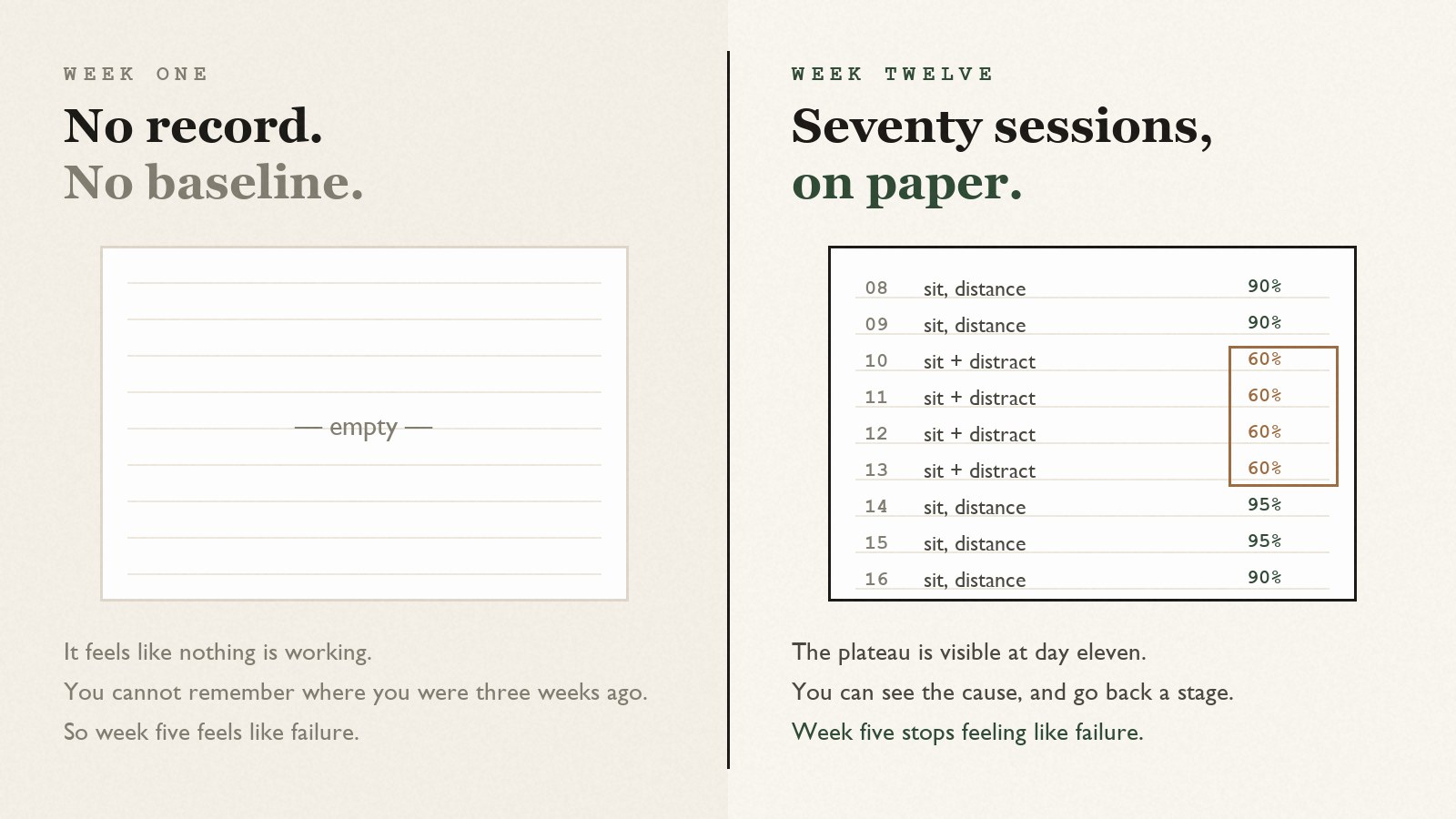
Before and after
We are not going to show you somebody else’s dog and call it proof. We will show you the thing twelve weeks actually changes, which is what your own logbook says.
Why equipment does not fix it
Pulling is not a bid for authority. It is a behaviour that has been reinforced by forward motion on every single walk of the dog's life.
Change the equipment and you change how uncomfortable pulling is. Change what gets paid and you change whether he pulls at all. The second one holds when the harness comes off.
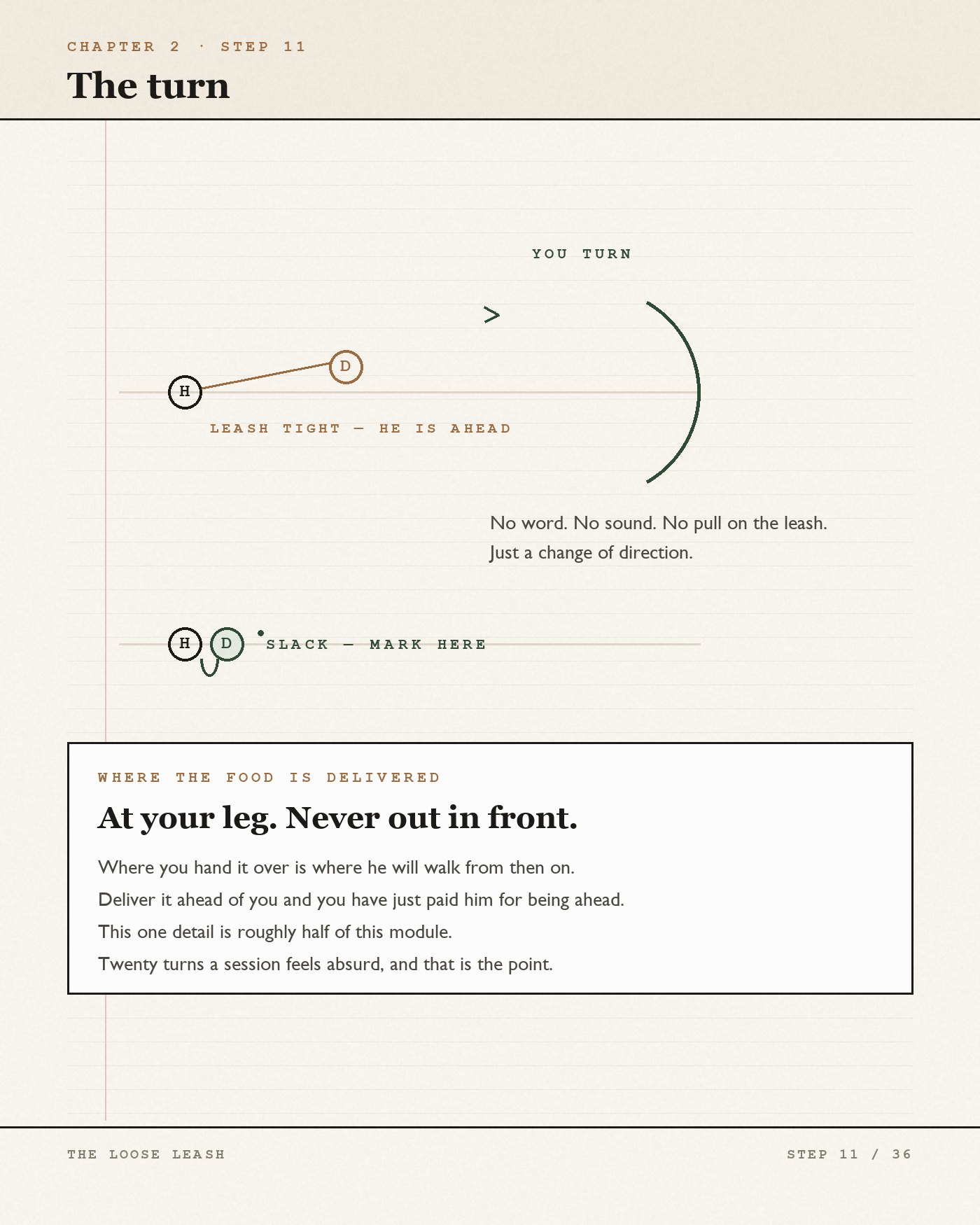
How a step is written
What you are teaching, where the marker lands, how many repetitions, and the mistake that teaches him the opposite.
Week 1
Week 2
Week 3
Thirty-three more steps across the hallway, the turn, the position, the street, and the dog who pulls only towards other dogs.
The method, in pictures
Sample pages
What you get
Thirty-six steps across five chapters — the hallway, the turn, the position, the street and the dog who pulls only at other dogs.
And every minute of it is a walk you were taking anyway.
Three weeks of the module happen before you reach a pavement, which is why it works on the pavement.
What each kind of gear does mechanically, with no brand named and nothing recommended as a fix.
The dog who is fine until another dog appears is a different problem, and it says so rather than pretending otherwise.
The ebook
Four weeks to a walk nobody dreads. Thirty-six steps, five chapters.
Take the module$37one-time · 60-day money-back guarantee
Instant digital download. One-time payment of $37, with a 60-day money-back guarantee. Educational material about dog training. This is not veterinary advice, not a behavioural diagnosis, and not a treatment. Aggression or biting is a matter for a veterinary behaviourist in person.
Chapter one, indoors, with a harness for your own safety while you teach. The module says which kind and why, and it is a safety measure rather than a fix.
It teaches loose-leash walking, which is a dog on a slack leash anywhere in a zone beside you. Competition heel is a different skill and the module says so.
That is chapter five, and it is treated as its own problem rather than as worse pulling.
It helps, because the marker and timing come from there. The module recaps both in chapter one for anyone starting here.
No. It explains what each type does mechanically and leaves the choice to you.
Most people notice a difference indoors in the first week. The street takes the four weeks, and dogs vary.
Write within 60 days and you get your money back. You keep the file.
The difference is what gets paid, and where you deliver it.
Take the module$37one-time · 60-day money-back guaranteeThis is educational material about dog training. It is not veterinary advice, not a behavioural diagnosis, and not a treatment for any condition. Aggression, biting, sudden changes in behaviour, and anything that frightens you or anyone else are matters for a veterinarian or a qualified veterinary behaviourist in person — not for a book. Dogs are individuals and no training method guarantees a result.