Week 1
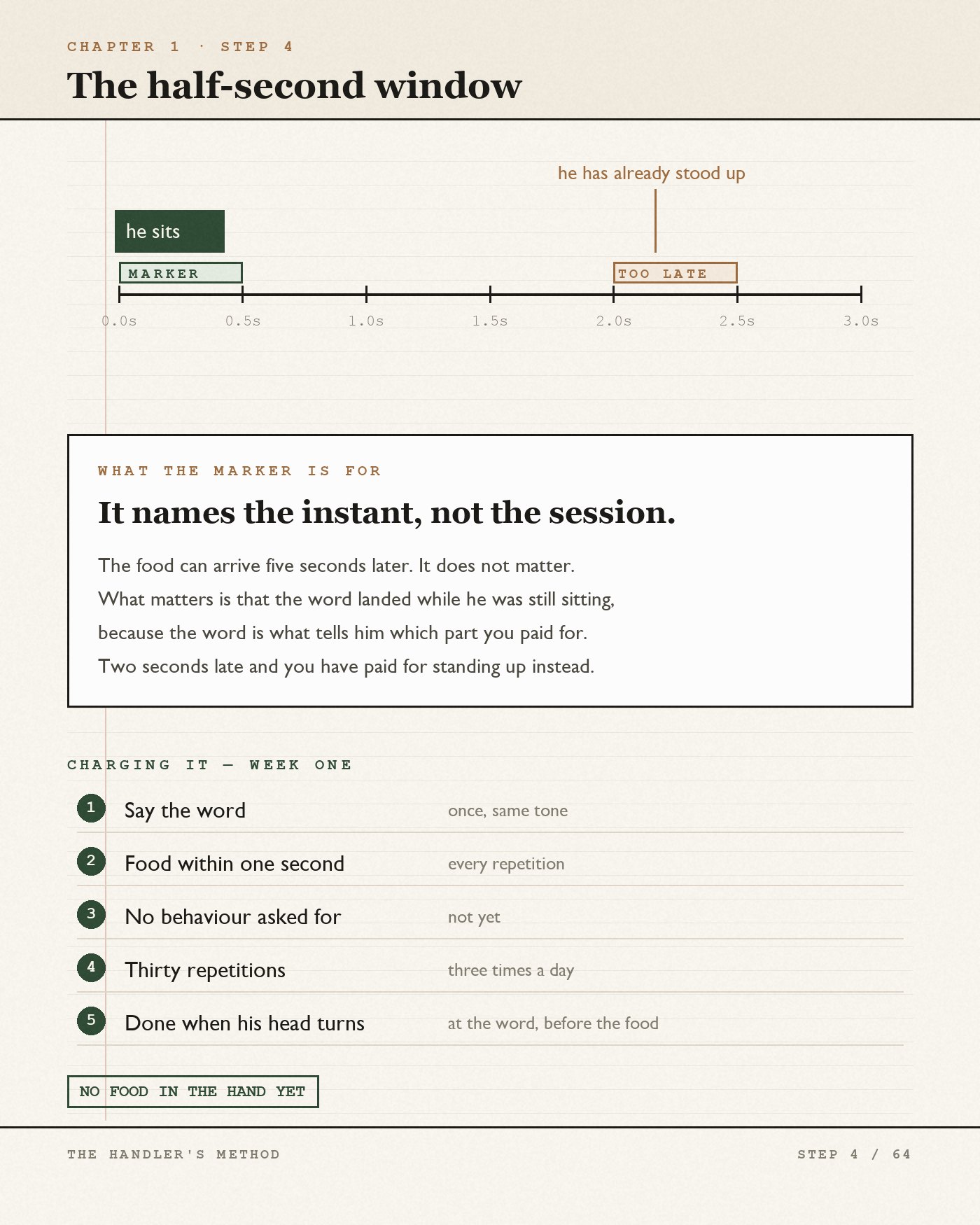
Charging The Marker
- Marker word, then food, within half a second
- Thirty repetitions, no behaviour asked for yet
- Done when his head turns at the word before the food appears
- Three sessions a day, ninety seconds each
The complete method
Twelve weeks from now: five commands that hold, and a dog who knows which half-second you liked.
Police dogs, detection dogs and assistance dogs are not trained harder than your dog. They are trained more clearly: one marker, timed to the half-second, and a reward schedule that means something. This is that method, written for one dog, one person and twenty minutes a day.
Begin the method$17one-time · 60-day money-back guarantee

What you get out of it
What a handler does differently
Police, detection and assistance dogs are not trained with more force than yours. They are trained with better information. Six differences, none of which costs anything, and all of which are missing from almost every household.
None of this is a secret. It is simply what gets taught on a handler's course and almost never reaches the person who bought a puppy, because nobody wrote it down in a form that fits twenty minutes a day.
Before and after
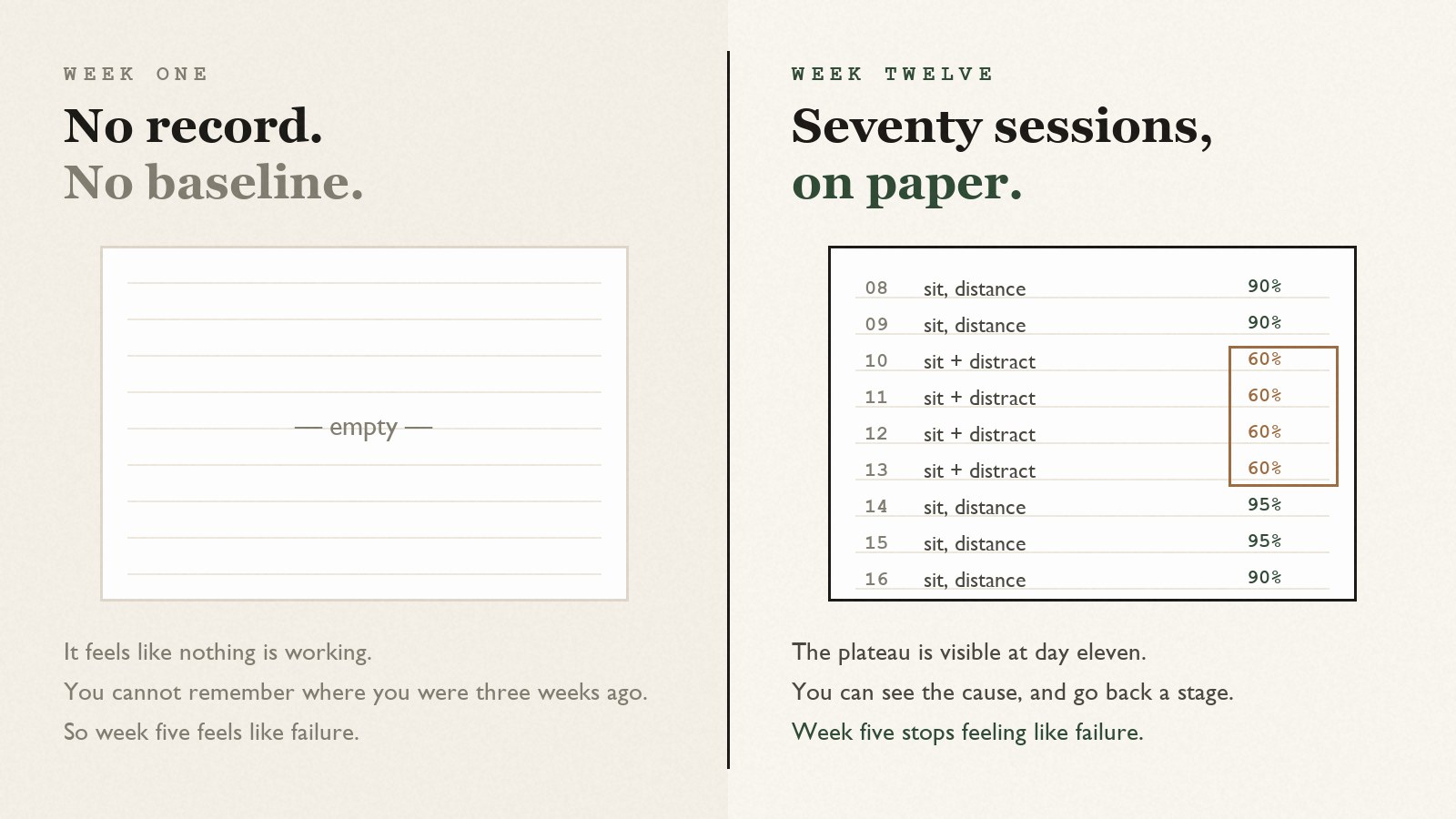
We are not going to show you somebody else’s dog and call it proof. We will show you the thing twelve weeks actually changes, which is what your own logbook says.
Why repeating it louder fails
You say sit, he sits, you say good boy two seconds later while he is already standing up. What you rewarded was standing up. Do that four hundred times and you have taught something, just not the thing you meant.
Working dogs get a marker — a word or a click — delivered within half a second, every time, that says exactly which instant earned the food. That one piece of timing is most of the difference between a pet that sort of listens and a dog that works.
How a step is written
What you are teaching, the exact timing, how many repetitions, what success looks like, and the mistake that teaches the dog the opposite.
Week 1
Week 4
Week 8
Sixty-one more steps across the marker, the schedule, the five commands, distance, duration, distraction and the handover to daily life.
The method, in pictures

The twelve weeks
What you get
Sixty-four steps across seven chapters and twelve weeks — the marker, the lure, the five commands, the schedule, the three variables and the handover.
Not for a class, and not for a trainer who is already standing there.
Every step says exactly when the marker lands. That timing is the single biggest difference between methods that work and methods that nearly work.
Three sessions of five minutes beat one of twenty. The method is built around the attention a dog actually has.
Aggression, biting and sudden change go to a vet behaviourist on the first page, not in an appendix.
The ebook
How working dogs are taught, written for one dog and twenty minutes a day. Sixty-four steps, seven chapters.
Begin the method$17one-time · 60-day money-back guarantee
Instant digital download. One-time payment of $17, with a 60-day money-back guarantee. Educational material about dog training. This is not veterinary advice, not a behavioural diagnosis, and not a treatment. Aggression or biting is a matter for a veterinary behaviourist in person.
No. Adult dogs learn markers quickly — often faster than puppies, because they settle sooner. The method does not assume a puppy at any point.
No. A word works, as long as it is the same word, said the same way, within half a second. Chapter one covers choosing between them.
They are not taught here. They depend on timing and on reading a dog that cannot be checked through a PDF, and that conversation belongs with a qualified trainer standing next to you.
Stop and see a veterinary behaviourist in person. That is not a training-book problem, and this method says so on its first page rather than in an appendix.
A portion of his daily ration, moved from the bowl to your pocket. Chapter two covers doing this without overfeeding.
One PDF, 6 × 9 inches, sixty-four steps across seven chapters, sized to read on a phone in a field. Emailed the moment you buy.
Work the first two weeks. If it is not what you expected, write within 60 days and you get your money back in full.
At the end you have five commands that hold, and a dog that knows which part you liked.
Begin the method$17one-time · 60-day money-back guaranteeThis is educational material about dog training. It is not veterinary advice, not a behavioural diagnosis, and not a treatment for any condition. Aggression, biting, sudden changes in behaviour, and anything that frightens you or anyone else are matters for a veterinarian or a qualified veterinary behaviourist in person — not for a book. Dogs are individuals and no training method guarantees a result.