Chapter 1
Four Things, Thirty Seconds
- What you worked on, in two words
- How many repetitions, and how many he got right
- The hardest condition he succeeded in
- One word about his state: keen, flat, distracted
Module · the record
Thirty seconds after each session, and week five stops feeling like failure.
Training progress is slow enough to be invisible day to day and obvious across a month — but only if it was written down. This module is what to record in thirty seconds after each session, how to read a plateau, and the one card that holds the five commands and their cues.
Take the module$12one-time · 60-day money-back guarantee
What you get out of it
What a handler does differently
Police, detection and assistance dogs are not trained with more force than yours. They are trained with better information. Six differences, none of which costs anything, and all of which are missing from almost every household.
None of this is a secret. It is simply what gets taught on a handler's course and almost never reaches the person who bought a puppy, because nobody wrote it down in a form that fits twenty minutes a day.
Before and after
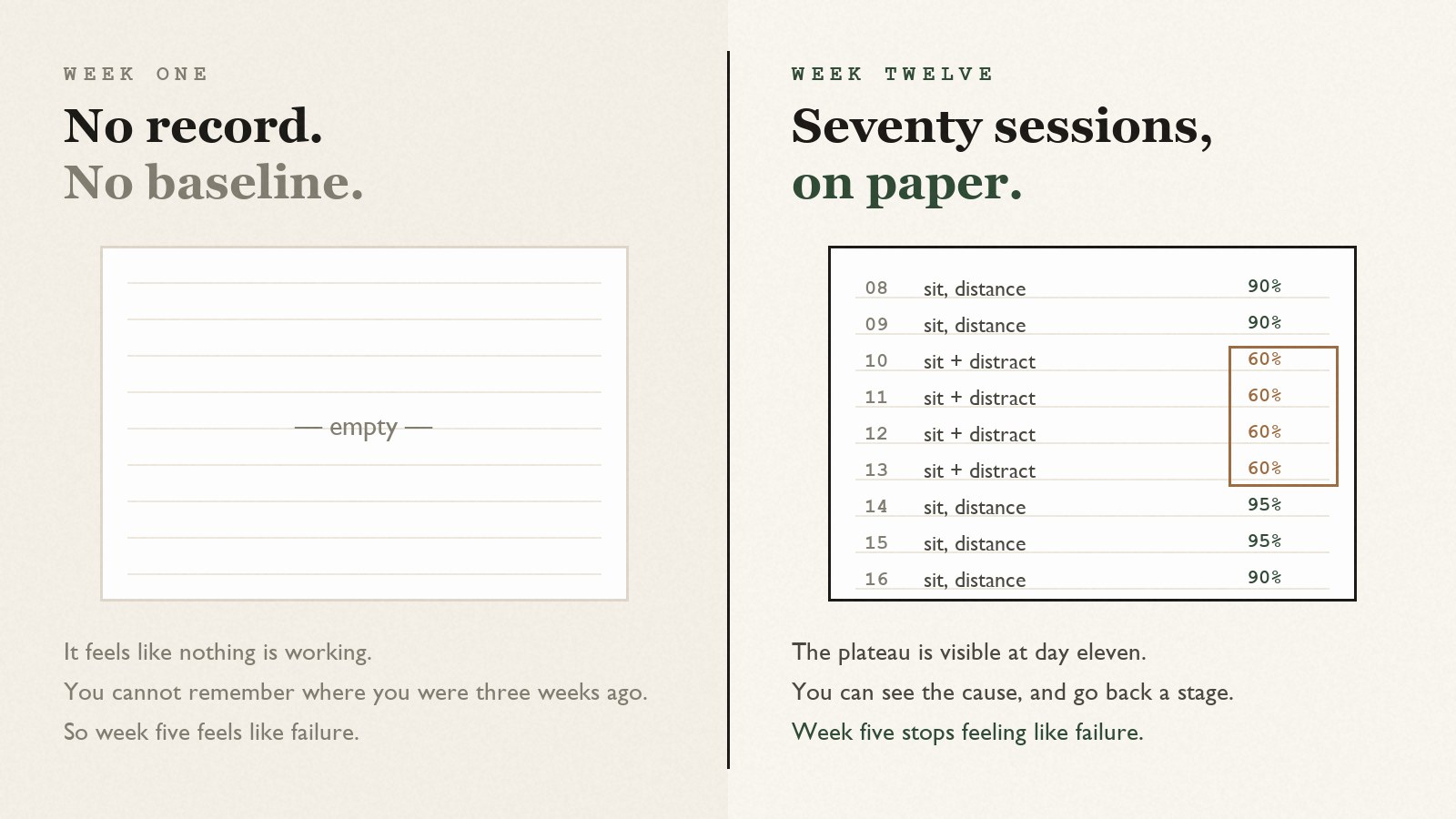
We are not going to show you somebody else’s dog and call it proof. We will show you the thing twelve weeks actually changes, which is what your own logbook says.
Why people quit at week five
Day to day, nothing changes. Across a month, a great deal does. Without a record you only ever experience the first of those.
Thirty seconds of writing after each session turns an invisible process into one you can read, argue with and adjust. It is the cheapest thing in this entire method and the one most often skipped.
How a step is written
What to record, in what form, and what the pattern means when you read it back.
Chapter 1
Chapter 2
Chapter 4
Twenty-one more steps across what to record, reading the pattern, the weekly review and the card.
The method, in pictures

Sample pages
What you get
Twenty-four steps across four chapters — what to record, reading the pattern, the weekly review and the handler's card.
The cheapest part of the method and the most skipped.
Twelve weeks laid out to print and keep with the lead, because a record in an app is a record nobody fills in.
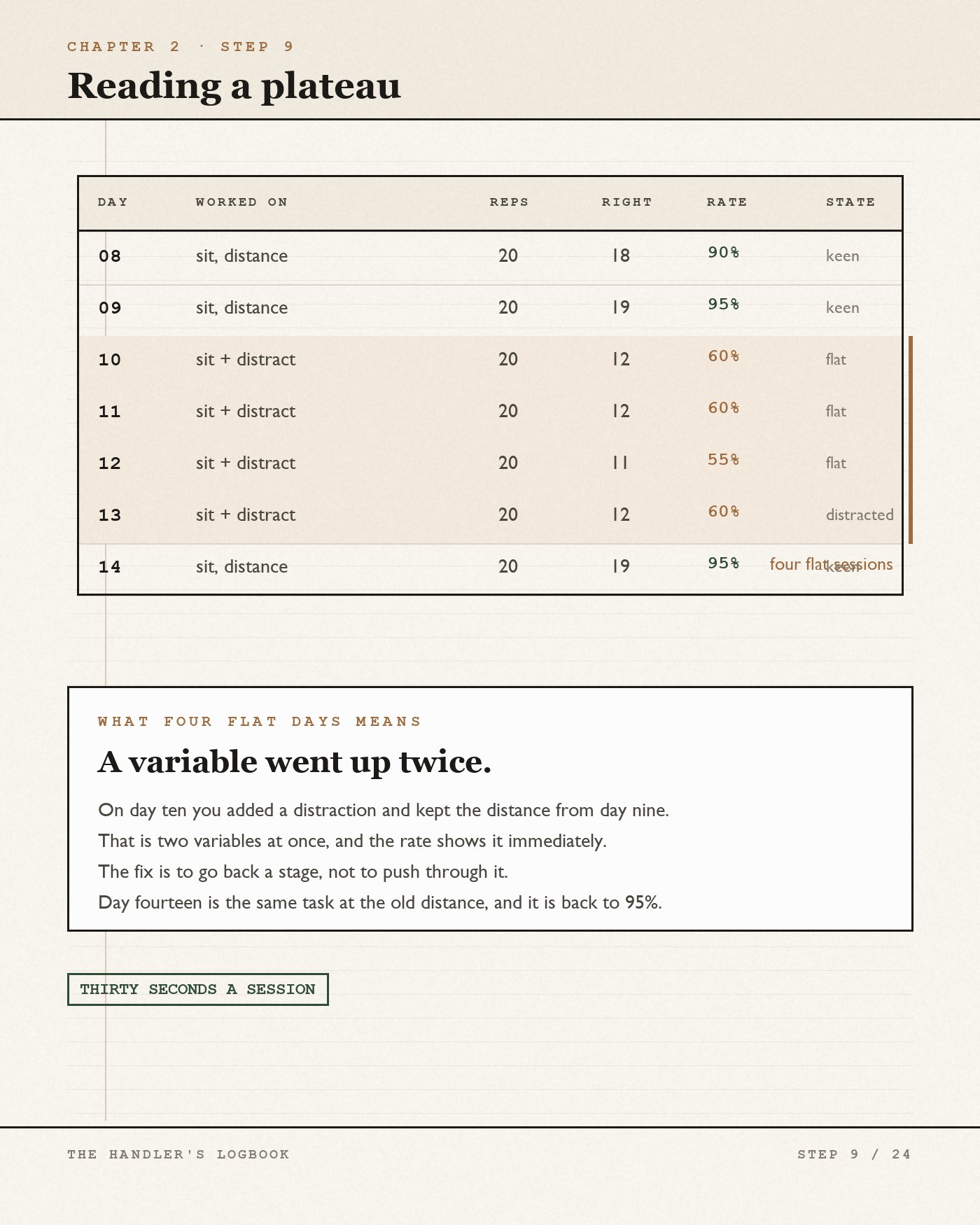
Six sessions flat means a variable went up twice. Without a record that is invisible and feels like failure.
The commonest cause of a confused dog is four people using four different words for the same thing.
The ebook
Thirty seconds a session, and progress stops being invisible. Twenty-four steps, four chapters.
Take the module$12one-time · 60-day money-back guarantee
Instant digital download. One-time payment of $12, with a 60-day money-back guarantee. Educational material about dog training. This is not veterinary advice, not a behavioural diagnosis, and not a treatment.
No. Twenty-four written steps on what to record and how to read it, plus twelve weeks of sheets at the back.
You can. Most people do not, which is why the sheets are designed to be printed and kept with the lead.
It pairs with it, but the logbook works alongside any training you are doing.
Six or more sessions at the same success rate. Chapter two covers reading it and the usual cause, which is two variables raised at once.
Because four people using four words for the same thing is the commonest reason a dog looks confused.
One PDF, 6 × 9 inches, emailed the moment you buy.
Write within 60 days and you get your money back. You keep the file.
So that week five feels like progress instead of failure.
Take the module$12one-time · 60-day money-back guaranteeThis is educational material about dog training. It is not veterinary advice, not a behavioural diagnosis, and not a treatment for any condition. Aggression, biting, sudden changes in behaviour, and anything that frightens you or anyone else are matters for a veterinarian or a qualified veterinary behaviourist in person — not for a book. Dogs are individuals and no training method guarantees a result.