The puppy module · 32 steps · the first eight weeks home

Module · the puppy

Most of what you will spend years fixing is decided in the first eight weeks he is home.

Eight weeks of deciding what normal looks like, while it is still cheap to decide.

Not because puppies are fragile, but because habits are cheap to build and expensive to replace. This module covers the window that does not reopen, the toilet schedule that actually works, the crate as a room rather than a cage, and the biting that frightens people and is entirely normal.

Take the module$27one-time · 60-day money-back guarantee

See the eight weeks ↓

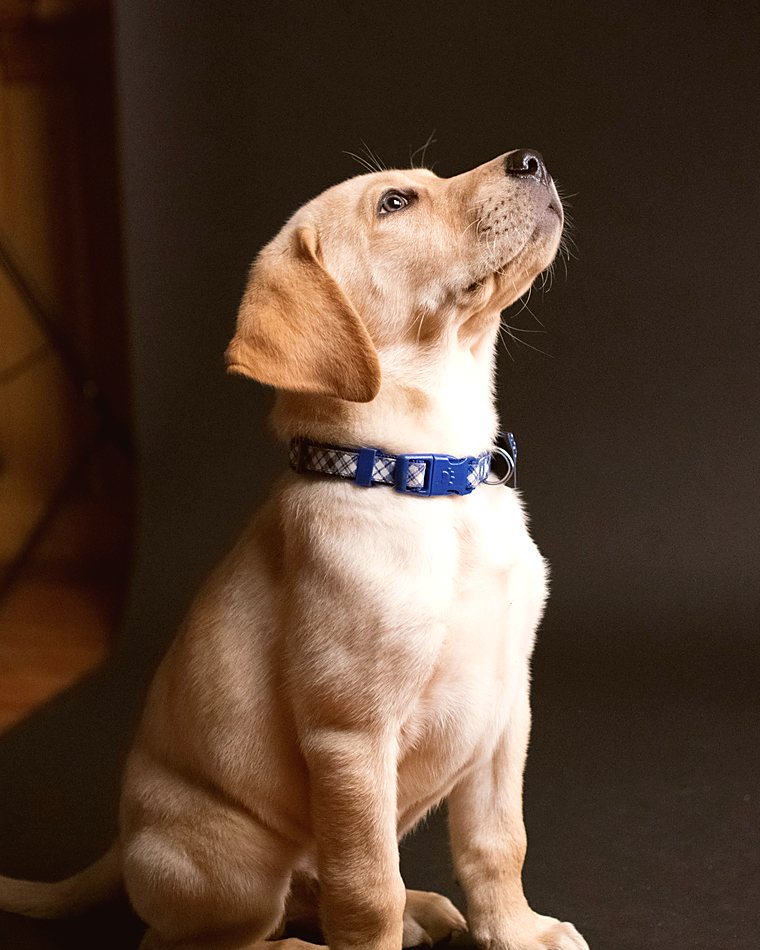
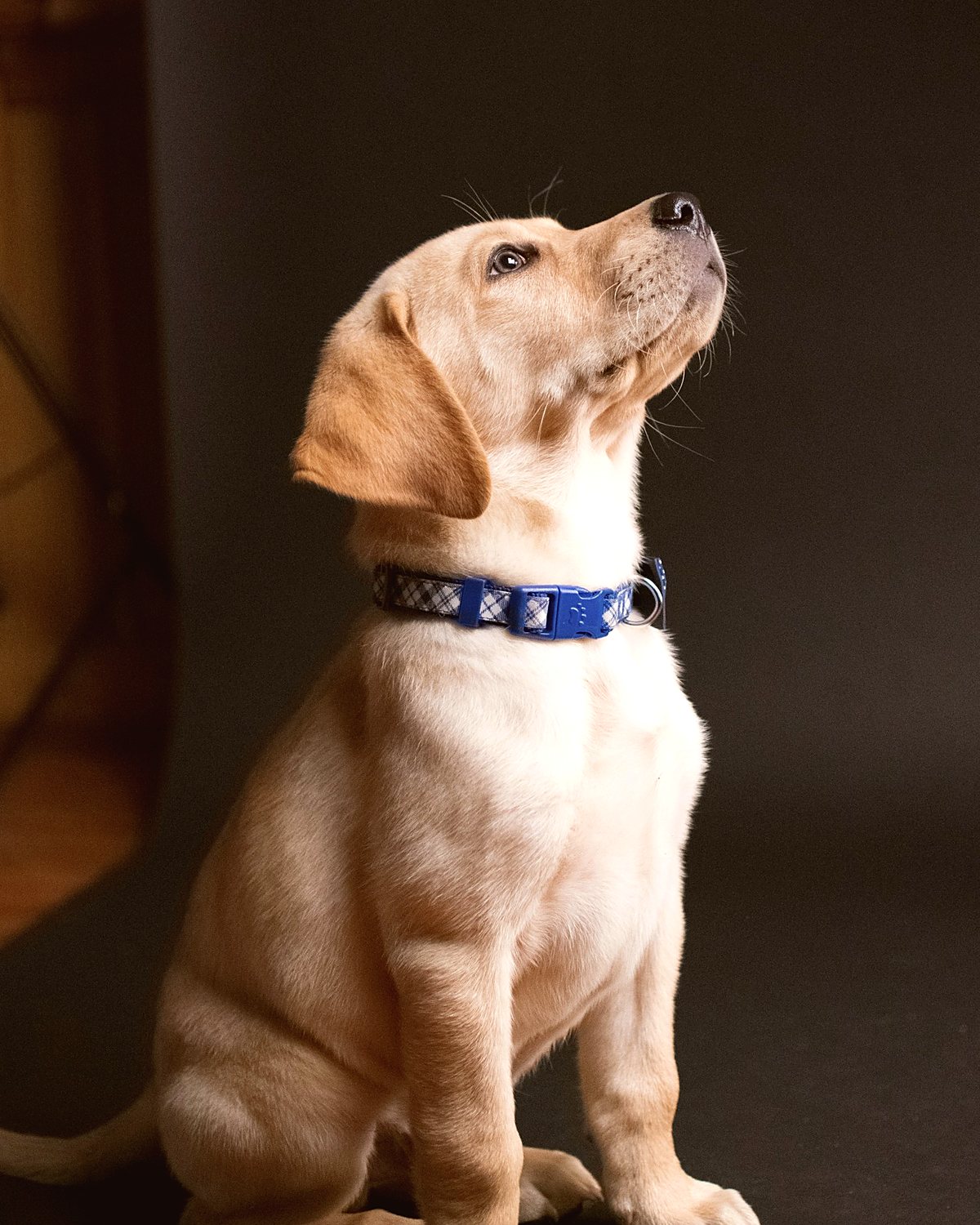
A young puppy looking upwards
Thirty-two stepsEight weeks of deciding what normal looks like.

What you get out of it

The First Eight Weeks gives you this.

What a handler does differently

Not firmer. Clearer, and timed to the half-second.

Police, detection and assistance dogs are not trained with more force than yours. They are trained with better information. Six differences, none of which costs anything, and all of which are missing from almost every household.

The method
Almost everyone else
A marker lands within half a second of the behaviour
'Good boy' two seconds later, by which time he is already standing up
One word, said once, in the same tone
The word repeated four times, louder each time, until it means nothing
The command is never given where it can be ignored
Called across a park, ignored, and called again — teaching that it is optional
One variable raised at a time: distance, duration, or distraction
All three at once, on the first good day, in a field full of dogs
Reward delivered where you want him standing
Reward tossed out in front, which is where he then goes
Sessions of five minutes, three times a day
One session of forty minutes at the weekend, ending in frustration

None of this is a secret. It is simply what gets taught on a handler's course and almost never reaches the person who bought a puppy, because nobody wrote it down in a form that fits twenty minutes a day.
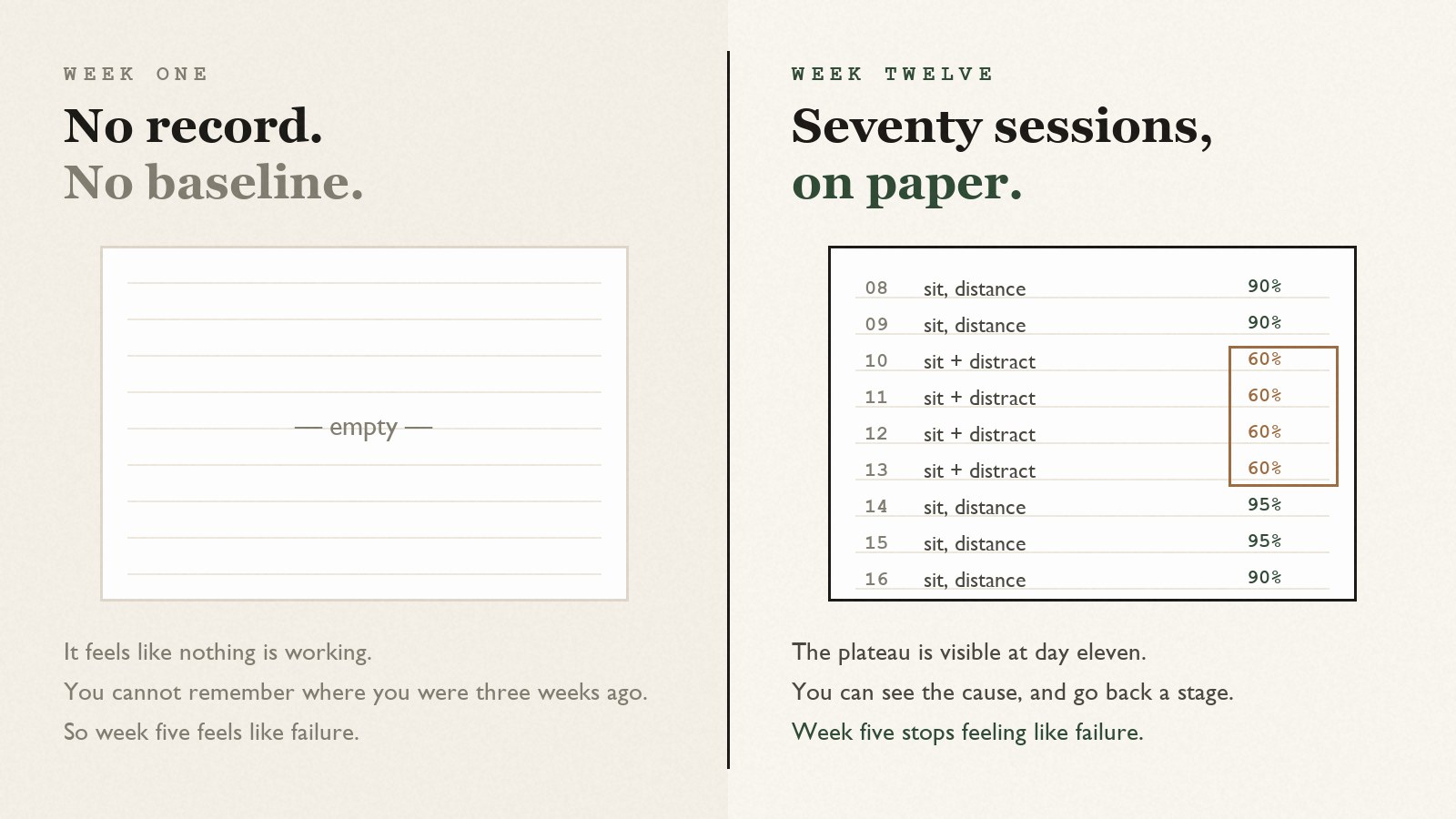
Before and after

Of the record, not of the dog.

We are not going to show you somebody else’s dog and call it proof. We will show you the thing twelve weeks actually changes, which is what your own logbook says.

A blank logbook page beside twelve weeks of filled-in session sheets
Week one: no record, no baseline, and a feeling that nothing is working Week twelve: seventy sessions on paper, and the plateau visible at day eleven

Why the early weeks matter

You are not training a puppy. You are deciding what normal looks like.

A puppy is building a model of what the world contains and whether it is alarming. Umbrellas, bicycles, men in hats, hard floors, the vet's table — each one is either ordinary or it is not, and that is largely settled early.

This is not a reason to panic. It is a reason to be deliberate for eight weeks about things that cost nothing.

How a step is written

Thirty-two steps, each on a page

What to do, how often, what counts as success, and the common version of it that teaches the opposite.

Week 1 home

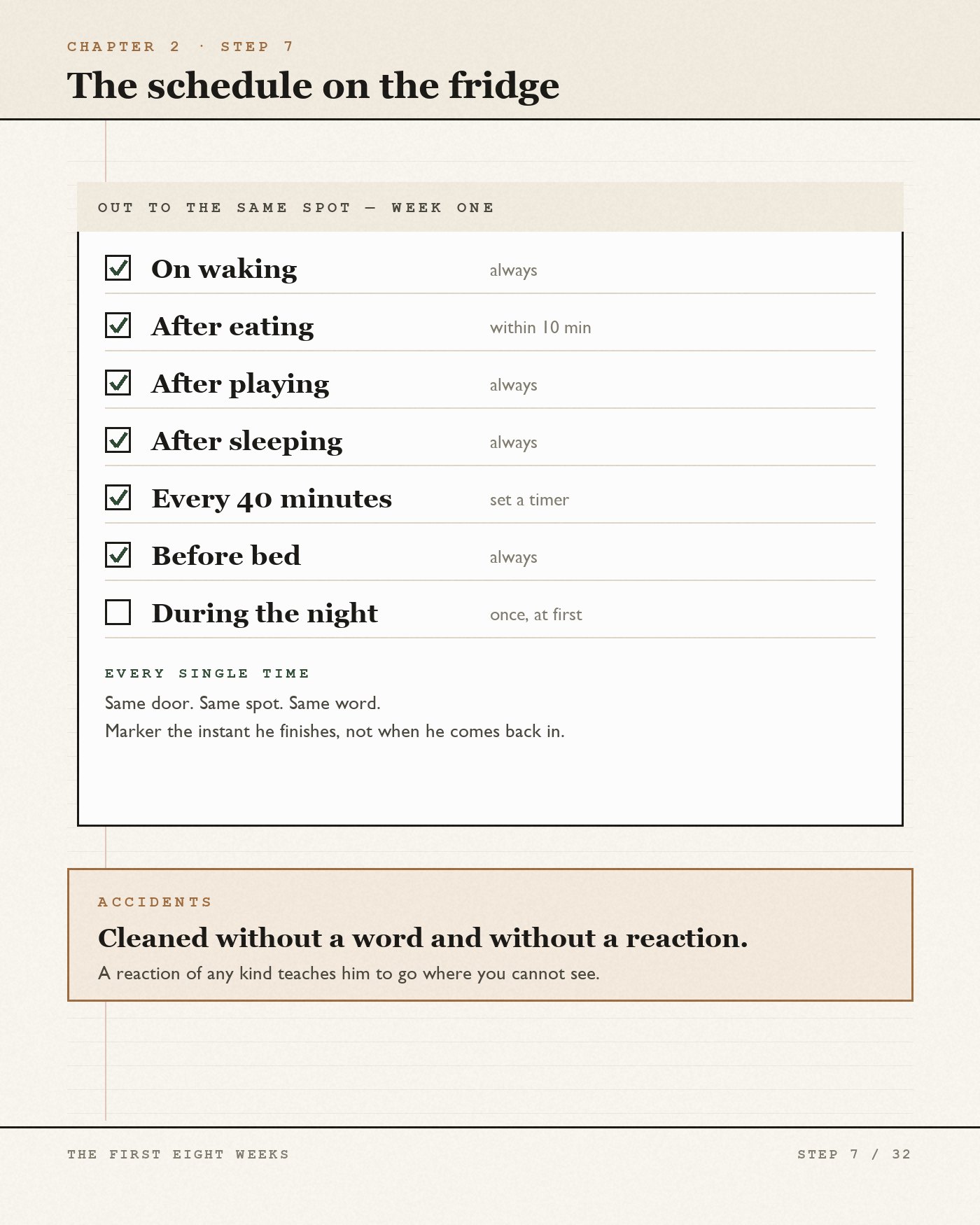
The Toilet Schedule

  • Out after sleeping, eating, playing and every forty minutes
  • Same door, same spot, same word, marker the instant he finishes
  • Accidents are cleaned without a word and without a reaction
  • A written schedule on the fridge, not a memory
Time all dayThree weeks

Week 2 home

Socialisation, Properly

  • Exposure at a distance he is comfortable with, never immersion
  • Food while the strange thing is visible, before it is close
  • If he freezes or retreats, you were too close — that is the whole gauge
  • Quality over a checklist of a hundred
Time 10 minSix weeks

Week 3 home

Biting Hands

  • Normal, developmental, and not aggression
  • The hand goes still and boring, not away and exciting
  • Redirect to something he is allowed to bite, then mark
  • Shouting makes the game better, which is why it fails
Time ongoingWeeks

Twenty-nine more steps across the first night, the crate, handling, the vet table, the lead and the habits that are cheap now.

The method, in pictures

What it looks like in a field.

The window
The windowHabits are cheap to build now and expensive to replace later.
Something he is allowed to bite
Something he is allowed to biteRedirect, then mark. Shouting makes the game better.
Handling, before the vet does
Handling, before the vet doesPaws, ears, mouth — so the table is not the first time.

Sample pages

A look inside

Week two home: the socialisation list, and what counts as an exposure rather than an ordeal.
An actual page from the PDF, at full size
  • The first night, and why it is loud whatever you do
  • A toilet schedule written on the fridge rather than remembered
  • Socialisation as distance and food, not as immersion
  • The crate as a room with a door, built over ten days
  • Biting: normal, developmental, and what actually reduces it
  • Handling — paws, ears, mouth — so the vet table is not the first time
  • The ten habits that cost nothing now and a year of work later

What you get

A module for the window that does not reopen

Thirty-two steps across five chapters — the first night, the toilet schedule, socialisation, the crate, biting and handling.

  • 32 stepsEach on its own page
  • 8 weeksFrom the first night
  • 5 chaptersNight one to handling
  • Instant accessThe moment you buy
  • A toilet schedule that goes on the fridge
  • Socialisation measured in distance, not in numbers met
  • The crate built over ten days as a room, not a cage
  • Handling practice so the vet table is not the first time

Eight weeks, then it is a dog

The module ends rather than becoming a subscription to worry.

Distance, not immersion

The commonest socialisation mistake is doing too much too close. The gauge is on every page.

The vet owns the health

Vaccination timing and when it is safe to walk in public are his questions, and the module says so instead of guessing.

Biting is normal

A whole chapter says so plainly, because this is what frightens new owners most and it is the least alarming thing in the module.

The ebook

The First Eight Weeks

The window that does not reopen, used deliberately. Thirty-two steps, five chapters.

Take the module$27one-time · 60-day money-back guarantee

Instant digital download. One-time payment of $27, with a 60-day money-back guarantee. Educational material about dog training. This is not veterinary advice. Vaccination timing and health questions are for your vet.

Questions

When can my puppy meet other dogs?

That is a vaccination question and it belongs with your vet. The module covers what to do with the answer they give you.

He bites constantly. Is he aggressive?

Puppy mouthing is normal and developmental. Chapter four covers it. If an adult dog bites, that is a veterinary behaviourist, not this module.

Is crate training cruel?

The module builds it as a room with a door over ten days, never as confinement, and says plainly when a crate is not the right choice.

My puppy is already five months old.

Most of the module still applies. The socialisation chapter notes what changes after the main window.

Do I need the method as well?

Not for the first eight weeks. The method is the natural next thing when he is ready for formal commands.

What exactly do I receive?

One PDF, 6 × 9 inches, emailed the moment you buy.

What if it is not for me?

Write within 60 days and you get your money back. You keep the file.

Eight weeks of deciding what normal looks like

Cheap to build now, expensive to replace later.

Take the module$27one-time · 60-day money-back guarantee

This is educational material about dog training. It is not veterinary advice, not a behavioural diagnosis, and not a treatment for any condition. Aggression, biting, sudden changes in behaviour, and anything that frightens you or anyone else are matters for a veterinarian or a qualified veterinary behaviourist in person — not for a book. Dogs are individuals and no training method guarantees a result.