The hardest module · 34 steps · built in seconds

Module · being left

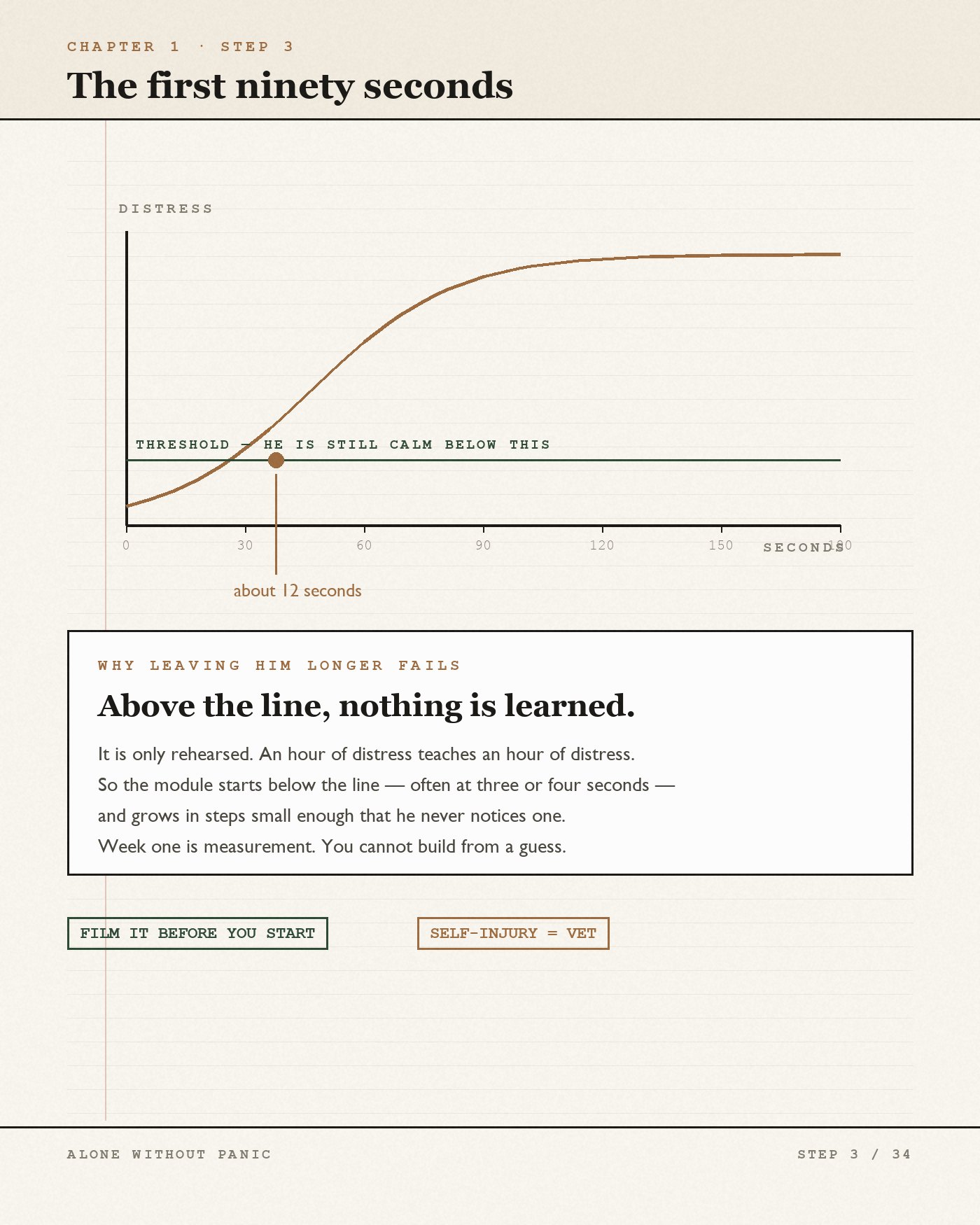
You have been practising the wrong thing. He does not panic after an hour. He panics in the first ninety seconds.

Start at three seconds and build so small he never finds out he was worried.

Which means every departure you have made has rehearsed the panic, not the calm. This module starts at the only place it can: a closed door for three seconds, with him under the threshold, built up in increments small enough that he never finds out he is worried.

Take the module$37one-time · 60-day money-back guarantee

See how it is built ↓

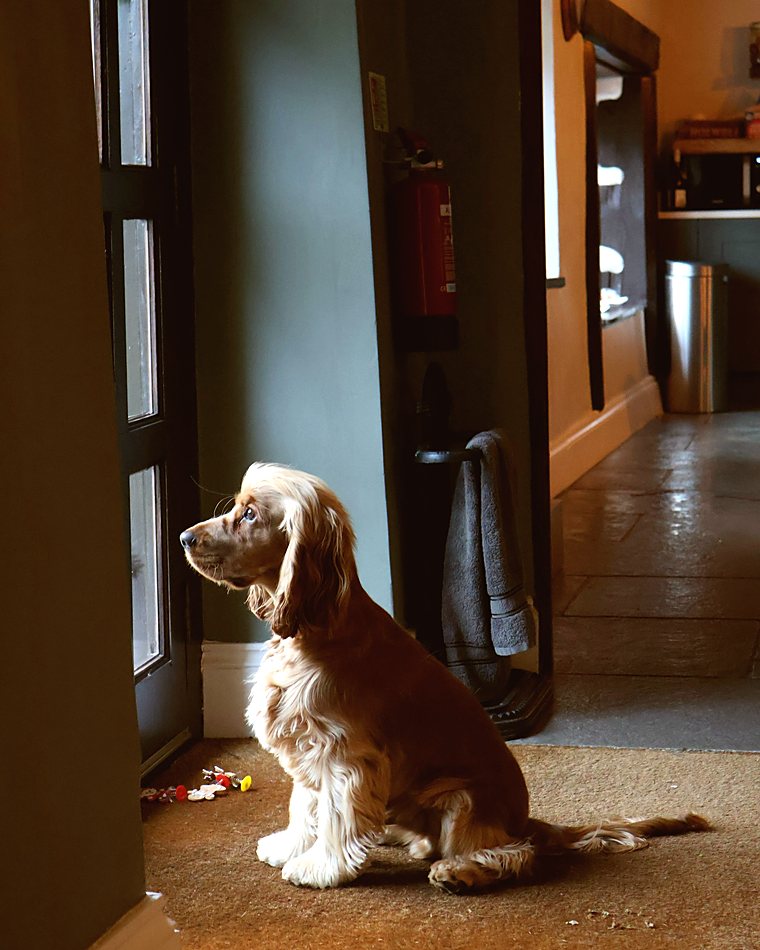
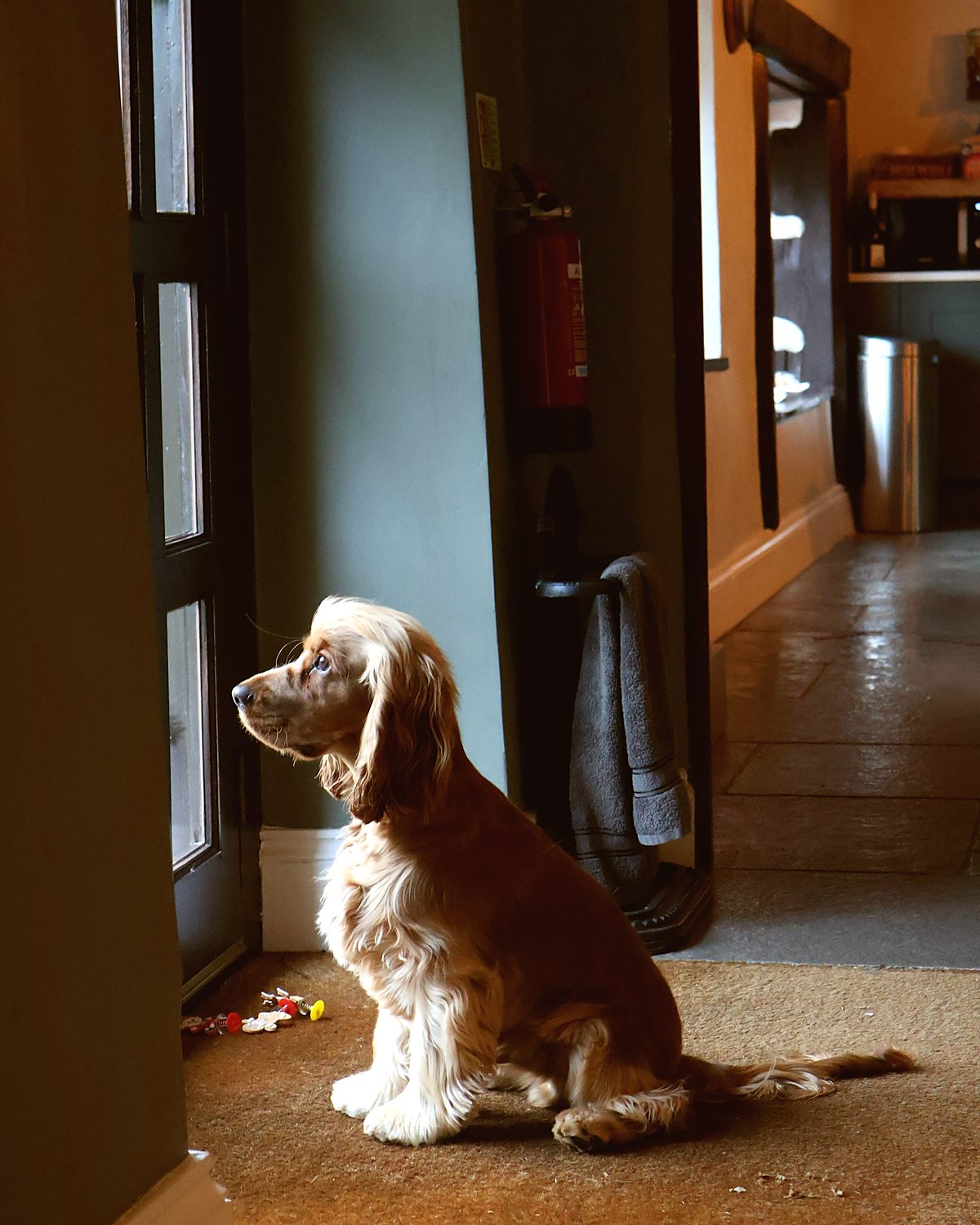
A dog sitting by a glass door, looking out
Thirty-four stepsThree seconds, then four. Built so small he never notices.

What you get out of it

Alone Without Panic gives you this.

What a handler does differently

Not firmer. Clearer, and timed to the half-second.

Police, detection and assistance dogs are not trained with more force than yours. They are trained with better information. Six differences, none of which costs anything, and all of which are missing from almost every household.

The method
Almost everyone else
A marker lands within half a second of the behaviour
'Good boy' two seconds later, by which time he is already standing up
One word, said once, in the same tone
The word repeated four times, louder each time, until it means nothing
The command is never given where it can be ignored
Called across a park, ignored, and called again — teaching that it is optional
One variable raised at a time: distance, duration, or distraction
All three at once, on the first good day, in a field full of dogs
Reward delivered where you want him standing
Reward tossed out in front, which is where he then goes
Sessions of five minutes, three times a day
One session of forty minutes at the weekend, ending in frustration

None of this is a secret. It is simply what gets taught on a handler's course and almost never reaches the person who bought a puppy, because nobody wrote it down in a form that fits twenty minutes a day.
Before and after

Of the record, not of the dog.

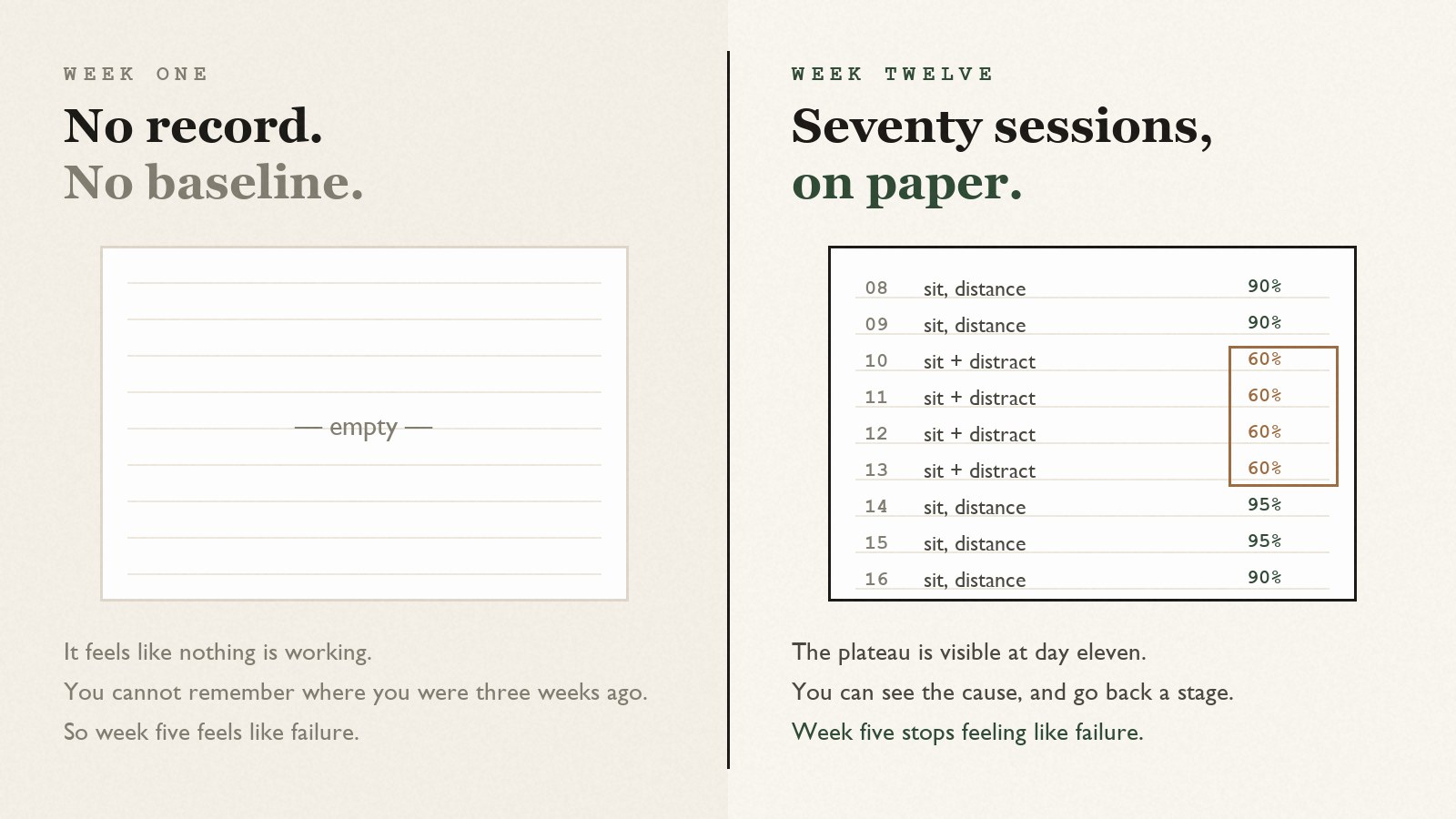
We are not going to show you somebody else’s dog and call it proof. We will show you the thing twelve weeks actually changes, which is what your own logbook says.

A blank logbook page beside twelve weeks of filled-in session sheets
Week one: no record, no baseline, and a feeling that nothing is working Week twelve: seventy sessions on paper, and the plateau visible at day eleven

Why leaving him longer fails

Nothing is learned above the threshold. It is only rehearsed.

The usual advice is to leave him a bit longer each time and let him get used to it. If he is distressed the whole time, what he is getting used to is being distressed.

The whole module is built on finding the duration at which he is still calm — often a handful of seconds — and growing it from there in increments so small that nothing changes for him.

How a step is written

Thirty-four steps, each on a page

What you do, for how long, what the camera should show, and when to go back a stage rather than forward.

Week 1

Measure, Do Not Guess

  • A phone on a shelf, recording, while you leave for two minutes
  • Watch the first ninety seconds frame by frame
  • Panting, pacing, whining, scratching — note the second each starts
  • That number is your starting point, and it is usually shocking
Time 2 minDone once

Week 2

Three Seconds

  • Door closed, three seconds, door opened, nothing said
  • Twenty repetitions a day, boring on purpose
  • No greeting, no fuss, no food on return
  • If he reacts at three seconds, the answer is one second
Time 10 minOne week

Week 4

The Departure Routine

  • Keys, coat and shoes, done at random times with no leaving
  • Until they predict nothing at all
  • The cues are the trigger far more often than the absence is
  • This chapter alone resolves some dogs
Time 5 minTwo weeks

Thirty-one more steps across measuring, the door, the departure cues, growing the duration and the weeks when it goes backwards.

The method, in pictures

What it looks like in a field.

The first ninety seconds
The first ninety secondsHe does not panic after an hour. He panics almost immediately.
Measured, not guessed
Measured, not guessedA phone on a shelf for two minutes. The number is usually shocking.
Three seconds, then four
Three seconds, then fourBuilt so small that nothing changes for him.

Sample pages

A look inside

Week one: the door closed for three seconds, and the camera that tells you whether that was already too long.
An actual page from the PDF, at full size
  • Filming a two-minute absence, and reading the first ninety seconds
  • Finding the duration at which he is still calm, which is often seconds
  • Three seconds, twenty times a day, deliberately boring
  • The departure cues — keys, coat, shoes — defused separately
  • Growing duration in increments small enough to be invisible
  • The weeks it goes backwards, which happen to nearly everyone
  • The line where this stops being a training problem

What you get

A module that starts at three seconds

Thirty-four steps across five chapters — measuring, the door, the departure cues, growing duration and the setbacks.

  • 34 stepsEach on its own page
  • Starts at3 seconds
  • 5 chaptersMeasure to maintain
  • Instant accessThe moment you buy
  • A filming protocol for week one, because guessing fails
  • Increments small enough that he never notices
  • The departure cues defused separately from the absence
  • A clear page on when this belongs with a vet instead

Built from where he actually is

Not from where the advice assumes he is.

Measured with a camera

You cannot build from a guess, and almost every guess is far too optimistic. Week one is measurement.

Increments that are invisible

If he notices the step up, the step was too big. That is the only rule governing the whole module.

It names the clinical line

Self-injury, destroyed exits and distress throughout every absence are a vet's problem. That page comes before step one.

The ebook

Alone Without Panic

Built in seconds rather than hours. Thirty-four steps, five chapters.

Take the module$37one-time · 60-day money-back guarantee

Instant digital download. One-time payment of $37, with a 60-day money-back guarantee. Educational material about dog training. This is not veterinary advice. Separation distress can be clinical; self-injury or distress throughout every absence is a matter for a veterinary behaviourist.

Questions

How long does this take?

Months rather than weeks, and the module says so on the first page. Anyone promising faster is not describing this problem.

He destroys the door when I leave.

Stop and see a veterinary behaviourist. Destruction of exits and self-injury are clinical signs, not training gaps.

Can I just leave him to cry it out?

No, and the module explains the mechanism: above the threshold nothing is learned, it is only rehearsed.

Do I need a camera?

A phone on a shelf is enough. Week one is measurement and it cannot be skipped.

What if I have to leave him for work tomorrow?

The module has a chapter on managing while you train, including what to arrange and what not to.

Do I need the method first?

No. This module stands alone and recaps what it needs.

What if it is not for me?

Write within 60 days and you get your money back. You keep the file.

Three seconds, then four

Built so small he never finds out he was worried.

Take the module$37one-time · 60-day money-back guarantee

This is educational material about dog training. It is not veterinary advice, not a behavioural diagnosis, and not a treatment for any condition. Aggression, biting, sudden changes in behaviour, and anything that frightens you or anyone else are matters for a veterinarian or a qualified veterinary behaviourist in person — not for a book. Dogs are individuals and no training method guarantees a result.